
Mogok Thorite With Gummite Alteration. A Tiny Crystal With a Big Gamma Story

Updated: Dec 29, 2025

Small specimens sometimes tell the most complete stories. This millimeter-scale Mogok thorite with gummite alteration carries the entire history of a radioactive mineral in miniature. It has been heated, altered, hydrated, cracked apart, and rebuilt through time. Somewhere in that process, the ThSiO4 framework began to open and uranium slipped outward to form the bright yellow and orange gummite rind that makes this tiny piece glow under UV.
Thorite and gummite alteration minerals are underdocumented online, so this post adds high-resolution photographic and spectral data that collectors and researchers can actually use. This little crystal has a lot to say, so let’s show how I measure it and how its spectrum reveals its story.
How These Measurements Are Made
Before looking at the spectrum, here is the workflow used in every article of this series. The goal is simple. Remove variables so that only the mineral changes.

The detector sits on a fixed acrylic stand that maintains a consistent distance from the specimen. A polished copper dome acts as the stage. It centers small crystals, provides the detector with a stable reflective surface, and maintains consistent geometry. The entire setup sits inside a three-sided alcove, so the detector sees only the mineral, not the rest of the room.
Before any specimen is introduced, a full one-hour background spectrum is collected. This provides a clean baseline with only natural room radiation. When the mineral spectrum rises above that baseline, we know exactly which features belong to the crystal.

Each mineral is then measured for twenty minutes in the same position. This is long enough to smooth out statistical noise and short enough for any reader with a Radiacode to repeat the process at home without feeling like they need to leave the detector running while they make dinner.
This standardized workflow will be used in every post. When you see two spectra compared side by side, they were collected under identical conditions. The gremlin in the data, if present, belongs to the rock.
Specimen Overview. Mogok Thorite With Gummite Alteration
This specimen comes from Mogok in the Mandalay Region of Myanmar. Mogok is best known for rubies, but it also produces radioactive minerals with serious personality. This tiny thorite crystal stands only a few millimeters tall yet consistently reads near 200 CPS in the standardized setup.

The dark central mass is the surviving thorite. The orange-to-yellow coating is gummite, a mixture of hydrated uranium oxides that forms when uranium migrates outward during alteration. Under UV light, this rind lights up beautifully, highlighting the pathways uranium took as it broke free from the thorite lattice.
Thorite Spectrum Analysis
The Mogok thorite returned a stable reading near 188 CPS over a twenty-minute acquisition. This is precisely what a tiny altered thorite with a gummite rind should produce.

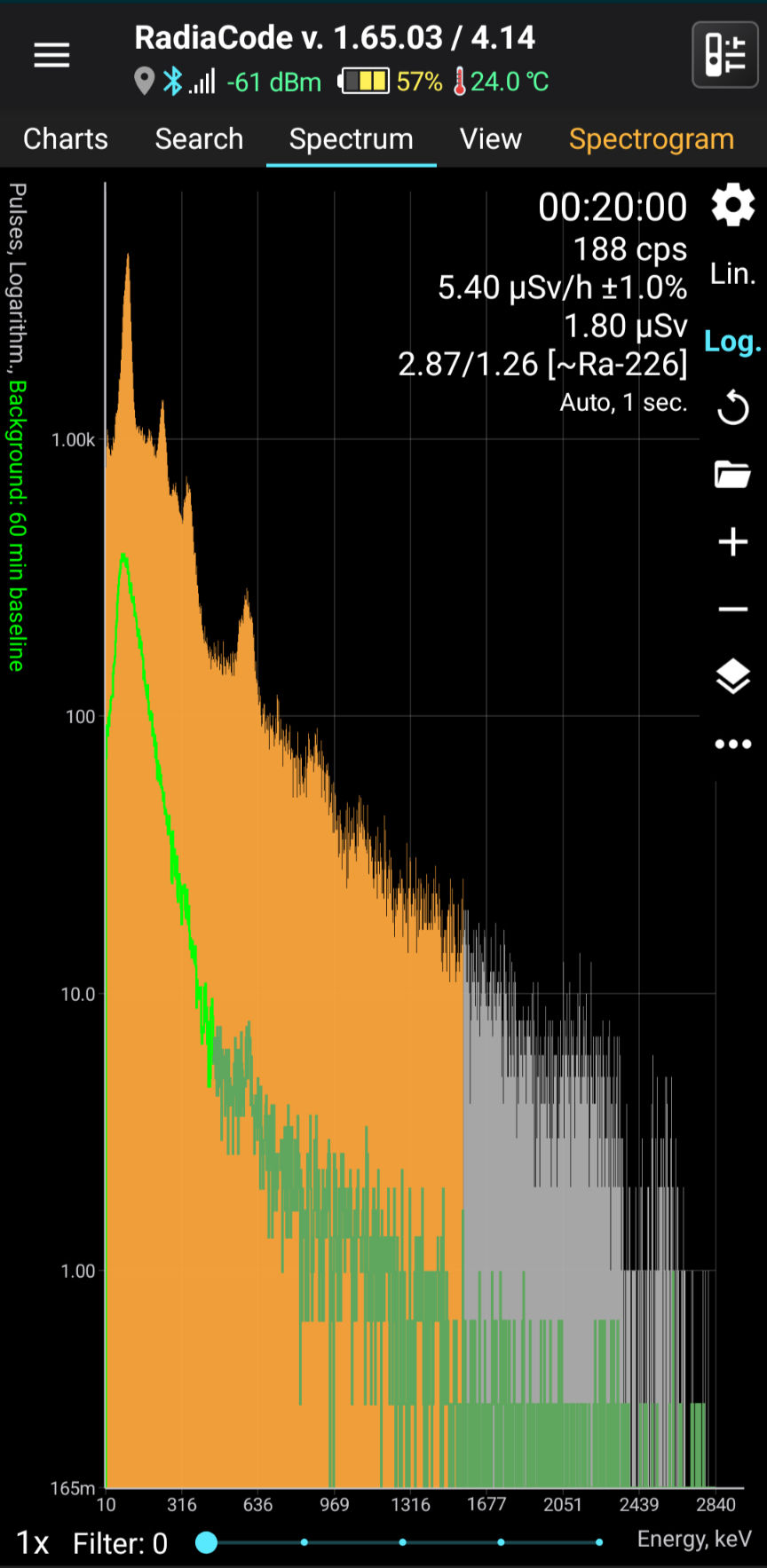
What the Spectrum Shows
• The thorium decay chain shapes the overall curve
• The Ra-226 indicator appears where expected for a ThSiO4-based mineral
• Lower energy gamma events are enriched by uranium in the gummite rind
• High-energy activity remains limited, which is normal for small thorite crystals
Thorite breaks down through metamictization and hydration. Uranium is more mobile than thorium, so it migrates outward and forms secondary oxides. Even a thin rind shifts the spectrum and gives the mineral a recognizable fingerprint. That is why altered thorite presents differently from pure thorium minerals or clean uranium ore.
There is beauty in this breakdown. A little scientific gremlin joy. A crystal that still holds its shape yet tells you, with data, how it has been slowly falling apart for millions of years.
Scale Context

This image shows the specimen's actual size. It is not large. It is not heavy. Yet it has the radiological footprint of something much bigger. Collectors often learn this lesson early. Chemistry drives activity, not size.
Spectrum Comparison. Thorite vs Uraninite
To understand where this thorite sits in the radioactive mineral world, it helps to compare it directly with a well-preserved uranium ore. Both minerals were measured in the same alcove, on the same dome, with the same baseline and the same acquisition time.
This is a clean comparison. The only difference is the mineral.
Reference Specimen. Uraninite From the Mi Vida Mine, Utah
The Mi Vida uraninite will get its own full write-up shortly. For now, it acts as a powerful reference point.

Even as a modest hand specimen, it produces far greater intensity and carries a complete uranium decay chain.
Uraninite Spectrum

Key Differences For Readers
• Uraninite reached more than 800 CPS in the same geometry
• High-energy gamma events between 1800 and 2600 keV are clearly expressed
• Uranium decay chain peaks appear sharply and consistently
• The energy distribution is broad and strong, typical of intact UO2 ore
Where thorite tells a story of weathering and uranium escape, uraninite tells a story of preservation.
Side-By-Side Interpretation

Intensity
Thorite. ~188 CPS
Uraninite. ~808 CPS
This difference illustrates how the composition and density of the decay chain shape the detector response.
Energy Structure
Thorite. Low energy enriched, broad slope typical of thorium with uranium alteration.Uraninite: High-energy, rich in uranium, full uranium chain distribution.
Geologic Story
Thorite. Alteration, hydration, metamictization, and uranium migration.Uraninite. Preserved UO2 lattice with minimal alteration.
This comparison helps readers understand why two minor radioactive minerals behave so differently under identical conditions and why controlled geometry matters when interpreting spectra.
Why This Matters
This thorite specimen is more than a millimeter-scale curiosity. It is a learning tool. It shows the exact moment where thorite gives up its uranium and begins to transition into bright secondary oxides. The spectrum records that history. The UV glow records it. The rind records it. Even the CPS reflects it.
Thorite may be small, but scientifically, it is a complete chapter in uranium weathering.
If You Collect Uranium Minerals
If you enjoy pieces like this, RadioactiveRock.com features a rotating selection of uranium minerals, alteration minerals, and fluorescent specimens tested using this same workflow. Availability changes often, and every specimen is documented with real measurements.
Up Next
I'll be featuring Ruggles Mine gummite it sets up the next step in this series perfectly. In the following post, I will move from alteration in pegmatites to a fully developed secondary uranium mineral by examining zippeite on uraninite from the Blue Lizard Mine. That specimen represents a later stage of uranium breakdown, where chemistry, hydration, and fluorescence become even more pronounced. Viewed through the same measurement setup, it will provide a clear contrast to the Ruggles slab and show how uranium alteration continues when conditions allow it to run its full course.
Stay curious, stay safe, and keep your detectors chirping.


Comments