
From Tunney’s Pasture Forward: Uraninite Wearable Artifacts and Atomic Cowboy Chic

A Uraninite Slab, Three Outcomes, Just in Time for a Radioactive Christmas
In an earlier post on Tunney’s Pasture, I focused on origin and context. This piece is about what happens after.
Some mineral stories start exactly how you expect. A field find. A mine dump. A labeled flat.
This one did not.
The slab arrived quietly, tucked into a paid order from RadioactiveRock.com as an unexpected gift. No warning. No note. Just a uranium-bearing slab with visible fracture networks, alteration halos, and a surface polish that told me someone stopped when the stone was ready, not when it was perfect.
At first glance, it was just another interesting radioactive rock.
It did not stay that way.
The material and why it stood out
The original material was recovered in the field by Jonathan Bélanger and later cut and polished by Mr. RadioactiveRock. It is not a classic mine specimen, and it does not pretend to be one. Its context lies closer to mid-century research and infrastructure than to commercial uranium extraction.
That in-between status is precisely what made it enjoyable.
The slab shows fracture-controlled alteration with uranium activity concentrated along weakness planes. Those fractures were left visible on purpose. They are not flaws. They are the record of how the material moved, altered, and settled over time.
This was a slab that rewarded slowing down.

Radiation readings that behaved exactly how they should
I took radiation readings at several stages, not to chase peak numbers but to understand how the material changed as its form changed.
On the raw slab with direct contact, readings were elevated, exactly where uranium-bearing rock should be. Once mass was reduced and a cabochon was cut, those numbers dropped. When the finished piece was mounted and measured at normal wear distance, readings settled close to background.
Nothing dramatic. Nothing spooky. Just geometry, distance, and physics doing what they always do.
The finished pieces are mechanically stable, sealed, and non-friable. They are not shedding dust, and they are not a surprise to anyone who understands how radioactive minerals actually behave outside of internet comment sections.


UV response and quiet details
Under UV illumination, faint fluorescence shows up along fracture zones and altered surfaces. It is a subtle green glow. No gimmicks. Just enough response to confirm secondary uranium involvement, where the rock already told you to look.
If you are expecting fireworks, this is not the kind of material you are looking for.
It rewards attention, not spectacle.

When a slab starts suggesting things
At some point, the slab stopped feeling like something to store and started feeling like something that wanted to become something.
Not every stone should be worked. Most should not. This one could be, without losing itself.
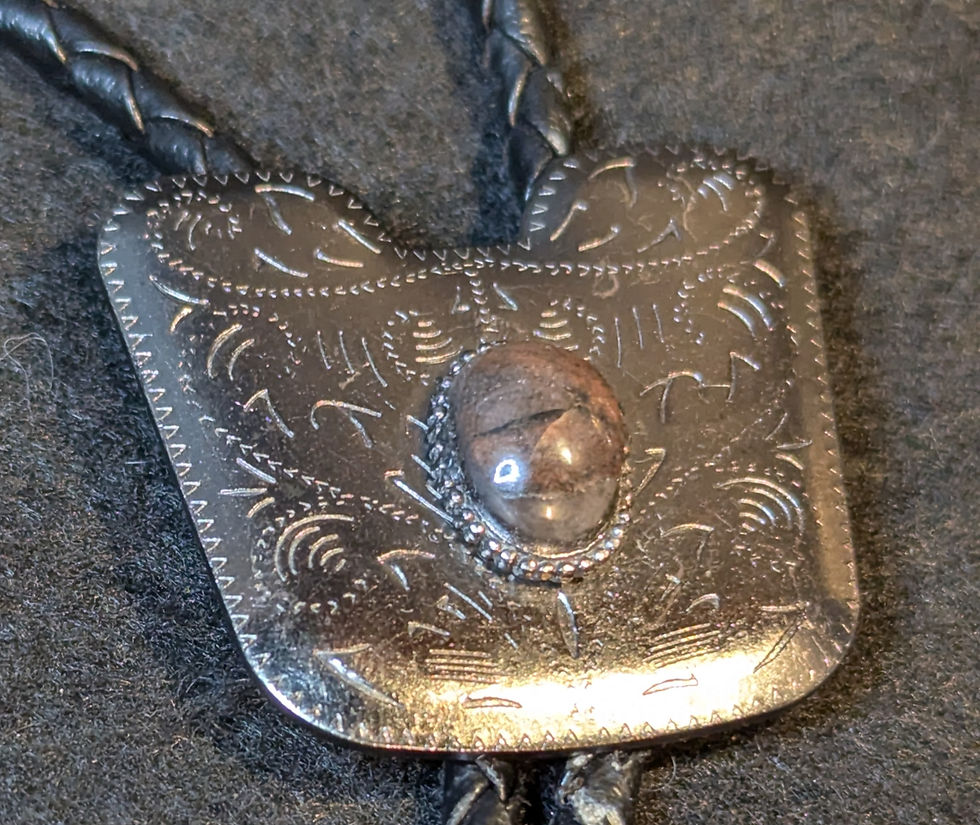
The cabochon was cut to preserve fracture continuity. The metal choices leaned toward industrial rather than precious metals. The goal was never jewelry. It was function, wear, and honesty.
Somewhere in that process, a familiar aesthetic surfaced without being named. Uranium. Western forms. Industrial metals. Objects meant to be worn, not entombed.
That was the quiet beginning of what I started calling Atomic Cowboy Chic. Not as a brand pitch. Just a way to describe why this felt right.

Three outcomes from one stone
The slab did not resolve into a single object. It resolved into three.
A bolo tie was made and returned to Jonathan Bélanger, the person who recovered the material in the field. A belt buckle was made and returned to Mr. RadioactiveRock, the person who slabbed and polished the stone. A reference portion of the original slab stayed with me.
None of this was planned. It emerged naturally as the work progressed.
As the finished pieces made their way back to the people who shaped them, the timing lined up in a way that was hard to ignore. It turned out to be a radioactive Christmas for all involved.


Distributed custody, not ownership
The slab entered my hands as a gift, and that mattered.
Instead of consolidating ownership or value, the outcomes were distributed. The finder received a finished object made from his discovery. The slabber wears a finished object made from his work. A reference portion remains preserved, so the material’s story stays anchored to something physical.
That is not sentimentality. It is stewardship.
Years from now, this story will not rely solely on memory. There will be multiple physical anchors held by the people who were part of the stone’s life at different stages.


Why this one was finished
Not every radioactive stone needs to become something wearable. Most should not.
This one earned it.
Its fractures, alteration, context, and quiet arrival made it less about possession and more about responsibility. Turning part of it into wearable objects did not erase its history. It gave it movement.
The remaining slab keeps the record honest.
Carried Forward, Not Carved Down
This was never about shock value or novelty. It was about respecting a piece of material that arrived through trust and letting it resolve without forcing it.
Some rocks are collected.
Some are sold.
A few become artifacts.
This one did.
And somewhere along the way, without trying to, it set the tone for something I plan to keep exploring. Atomic age materials. Western forms. Objects meant to be worn, questioned, and understood.
Atomic Cowboy Chic did not start as an idea. It began as a rock that refused to stay just a rock.
Stay curious, stay safe, and keep your detectors chirping.
What a nice adventure it was finding this rock. It's always fun seeing enthusiasm in the community. Happy to be part of it! Keep on hunting!
This is one of the reasons I love this field. It brings us out to nature, brings us together, and rewards us with friendship and artistic expression.