
Botryoidal Uraninite from Příbram: The Spiciest Rock in My Collection

Botryoidal uraninite from Příbram does not ask for your attention. It takes it. This is one of the strongest naturally radioactive specimens produced anywhere in the world, and the morphology alone makes it a collector's favorite. The Příbram district in the Czech Republic has long been a reference locality for well-crystallized UO2, and the botryoidal habit is one of the most visually striking forms uranium ore can take.
This piece combines that rare texture, high density, and serious radiation output. Every bubble-like dome is a miniature uranium lens, and the surface looks almost volcanic even though the mineral formed from hydrothermal fluids deep underground.
What Makes Příbram Botryoidal Uraninite Special
Botryoidal uraninite is uncommon because it forms under specific geochemical conditions. Instead of forming cubic crystals, the uraninite precipitated as layers of tiny radiating growths that built up into smooth, rounded forms. This creates the classic grape-like surface.
Collectors value these pieces for several reasons.
• They show uranium mineralogy in its most dramatic form
• The morphology increases surface area for alpha emission
• The texture makes the radiation behavior more dynamic on the detectors
• They represent some of the richest historic uranium ore ever mined
Příbram material is especially dense, dark, and often intergrown with quartz and iron oxides that contrast beautifully with the black uraninite masses.

Radiation Readings: Comparing Detectors
This specimen is not shy. When you bring a detector close, it immediately lets you know you are holding something powerful.
These readings captured two critical things.
• Distance matters
• Detector design matters even more
RadiaCode 103 Contact Reading
4.25 kCPS This is precisely what a dense piece of Příbram uraninite should do. Alpha heavy, gamma present, and a steady output strong enough to peg attention.
RadiaCode Slightly Elevated Reading
1.55 kCPS This demonstrates how quickly the reading drops as distance increases. Alpha is almost entirely lost, even with a small gap.


GMC-300S CPM Reading
This is where detector comparisons get fun.
The GMC-300S measured: 30,406 CPM
Collectors often ask why CPM on a basic Geiger counter looks so dramatic compared to CPS on a high-end sensor.
The answer is simple.
• CPM counts everything without discrimination
• It has lower dead time
• It saturates easily on hot material
• It cannot separate alpha, beta, and gamma signals
A GMC reading of 30,406 CPM is attention-grabbing, but the RadiaCode provides a more scientifically meaningful measurement.
Use both, and you get a complete picture.

Why Příbram Uraninite Is So Influential
Příbram is a cornerstone locality in uranium mineralogy for several reasons.
• It produced world-class primary UO2
• Alpha activity is extreme due to high purity
• Botryoidal forms are well documented and highly collectible
• Many historical studies of uranium decay products used Příbram ore
This specimen shows:
• Pure uraninite cores
• Concentric growth patterns
• Minor quartz vein material
• Microfractures from old hydrothermal alteration
It is as classic a uranium ore specimen as it gets.

Radiacode Spectrum Analysis
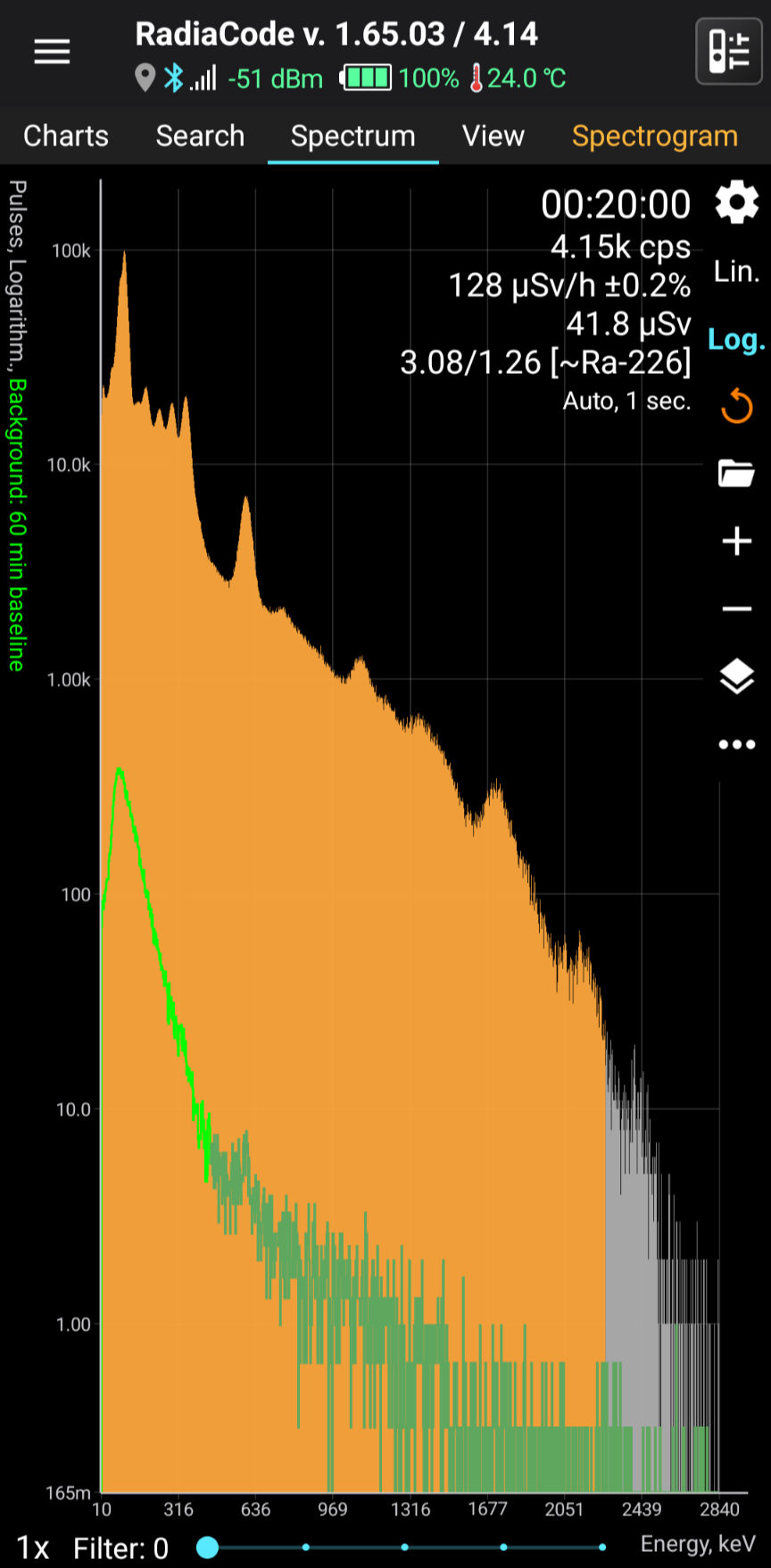
Before moving on to the thorite preview, it is worth looking at how this Příbram specimen behaves when the RadiaCode 103 is allowed to speak for itself. Botryoidal uraninite is dense, chemically simple, and decay-chain pure, so it produces a very recognizable spectral shape.
Here is the spectrum from the RadiaCode 103 positioned in the same controlled geometry used for all blog measurements.
What the Spectrum Shows
• High-energy gamma expression is strong and clean, which is typical of high-purity UO2
• Multiple U decay chain peaks stand out sharply
• Very high count intensity gives the curve a tall, steep rise that immediately differentiates it from altered uranium species
• Minimal low-energy noise because there is almost no silica weathering rind
• Textbook “Příbram profile” that collectors and researchers recognize: pure ore, minor alteration, maximum physics
Even with a botryoidal texture, the spectrum behaves like classic ore rather than weathered material. This is one of the reasons Příbram specimens remain reference standards in uranium mineralogy.
How This Specimen Fits Into My Hot Box
In my Hot Box, this piece sits on the top tier because nothing else in the case behaves quite like it. Even the autunite and Utah ore look polite next to this one. It represents the pure end of the uranium mineral spectrum. Heavy, rich, and unmistakably energetic.
This is the rock that reminds visitors why uranium minerals deserve respect and study.
Up Next
Next, I will be looking at a tiny but fierce specimen from Mogok. This little thorite crystal with gummite alteration may only stand a few millimeters tall, but it still delivers a clean 251 CPS and a complete lesson in uranium weathering. Mogok is famous for rubies, yet its radioactive minerals have their own strange charm, and this one shows the exact moment thorite breaks down into bright uranium oxides.
Small specimen, big science.
If pieces like this Příbram botryoidal uraninite catch your attention, you are not alone. High-grade uranium minerals with rare textures do not often come onto the market, and when they do, it helps to know what you are looking at. RadioactiveRock.com keeps a curated selection of uranium minerals that follow the same testing workflow used in this article. Every specimen listed has real CPS data, UV behavior notes, and geologic context.
If you want to compare spectra or find a specimen that matches your collecting goals, feel free to explore the shop or reach out. I am always happy to talk minerals, answer questions, or help match collectors with the right piece for their display case.
Stay curious, stay safe, and keep your detectors chirping.


Very much appreciate all the information! Great writeup!